Research
I study how political actors argue in public, and in particular how they answer criticism. My work sits where political communication, rhetoric, and international relations meet.
The research programme
- Interests
- Political communication and rhetoric, leadership communication and accountability, argumentation and deliberation, and media and politics
- Methods
- Qualitative hand coding, interviews, machine learning in Python, and duoethnography
- Languages
- Native Russian and fluent English, with conversational Italian and Tajik
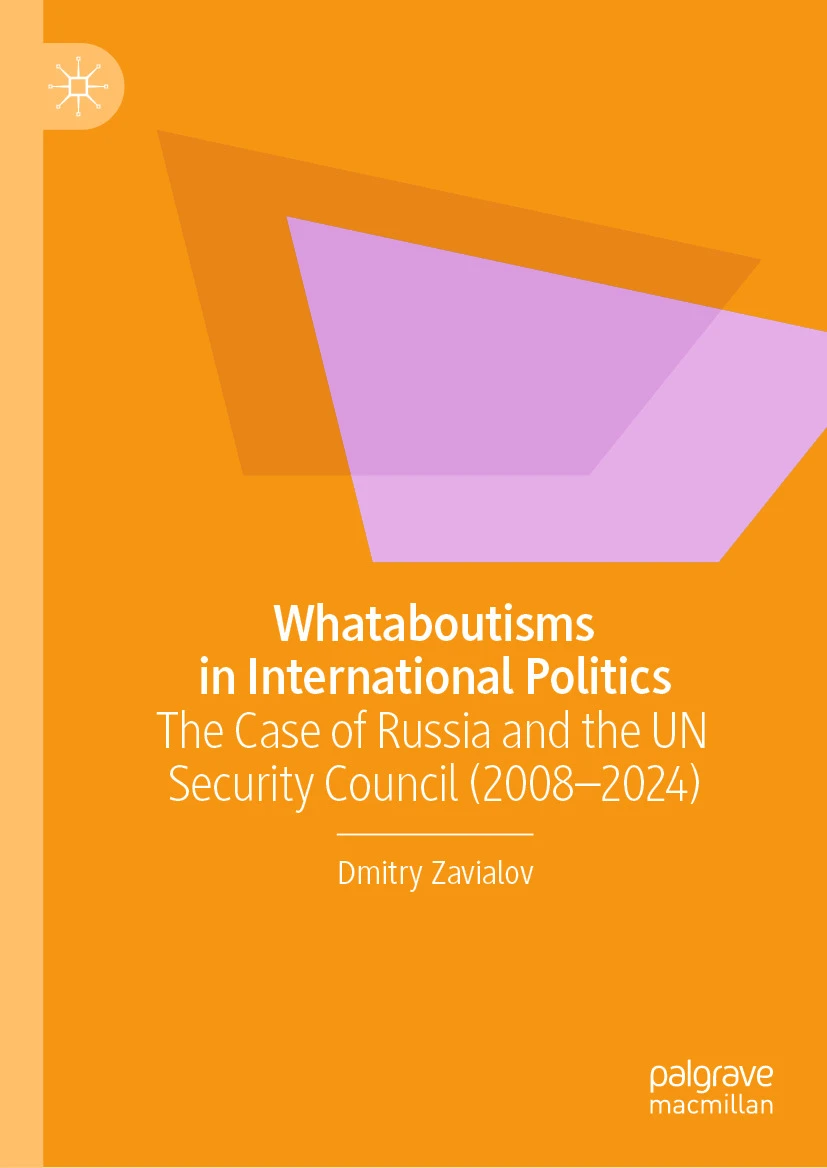
My research asks how political actors argue when they are criticised, and why some answers work. Its centre is whataboutism, the reply that meets a criticism by pointing at somebody else’s fault, and its close relative, the tu quoque. My doctoral thesis at the University of Otago traced these modes of argument in international relations with mixed methods, combining hand coding and interviews with a machine learning model. The book that grew from it, Whataboutisms in International Politics (Palgrave Macmillan, 2025), studies Russia at the United Nations Security Council between 2008 and 2024.
Although the setting is diplomatic, the work belongs to communication scholarship. It speaks to argumentation theory, where the tu quoque has long been treated as a fallacy, by asking when it works instead as a challenge to the accuser’s standing. It connects with research on image repair and crisis communication, where attacking the accuser is a recognised response strategy, and with work on equivocation and evasion, where counter-accusation can act as a red herring that draws attention away from the original question. Its underlying question concerns accountability: what happens to it when criticism is met with counter-accusation rather than an answer?
I have since extended the work in two directions. The first is comparative: how states of the Global South use and resist the same moves at the Security Council, the subject of an article in the Sri Lanka Journal of International Relations and of a paper at the University of Colombo. The second concerns the emotional register of diplomatic speech, in a paper on hope and hopelessness in Security Council rhetoric. I have also been invited to contribute a chapter to an edited volume on the Security Council and the General Assembly.
Earlier work examined propaganda and the control of information, from my master’s thesis on Russia’s capacity for information warfare to commentary on media control in Russia, written for Newsroom in 2022.
Alongside this runs a strand on communication and deliberation in practice: how people learn to disagree in good faith, and how walking side by side changes a conversation. A duoethnography of walking-based methods in tertiary education is under review, and the public forums I run in Auckland are where these questions are tested.
Where the research goes next
The work above is published. What follows are the questions I intend to pursue, which carry it from international forums into public dialogue.
- Deflection beyond diplomacy. How political and organisational leaders in Aotearoa New Zealand answer criticism in parliamentary exchanges, in media statements, and on social media, where an answer reaches a mass audience rather than a room of diplomats, and how audiences judge them when they deflect rather than respond. The project would combine an annotated corpus, built by adapting the classification approach from my doctoral work, with an audience study comparing how counter-accusation and a direct answer affect trust and perceived accountability.
- The conditions for constructive disagreement. Which features of a setting, such as a shared framing, explicit ground rules, or walking side by side, help strangers to disagree well, studied in community forums with the participants’ consent and full ethical approval.
Taken together, these move the work from describing how political actors avoid engaging with criticism towards asking what helps people engage with it.
Publications
Book
- Zavialov, D. (2025). Whataboutisms in International Politics: The Case of Russia and the UN Security Council. Palgrave Macmillan. doi:10.1007/978-981-95-0413-8
Journal articles
- Zavialov, D. (2026). Global South Agency and Whataboutism in the UN Security Council: Imperatives and Impediments. Sri Lanka Journal of International Relations, 3, 98–123.
- Zavialov, D. (2025). Whataboutery at the United Nations Security Council. International Politics. doi:10.1057/s41311-025-00702-z
- Cantini, N., and Zavialov, D. (2018). Fixing Responsibility to Protect: Lessons from and Proposals for the Case of Libya. Peace Human Rights Governance, 2(1), 75–96. doi:10.14658/PUPJ-PHRG-2018-1-4
Under review
- Zavialov, D., and Halcomb-Smith, L. Walking Side by Side: A Duoethnography of Walking-Based Methods in Tertiary Education. Reconceptualizing Educational Research Methodology.
In preparation
- Zavialov, D. Invited chapter in an edited volume on the UN Security Council and General Assembly.
Thesis
- Zavialov, D. (2024). Modes of Argument in International Relations: The Role of Whataboutisms and Tu Quoques. PhD thesis, University of Otago.
Commentary
- Dibrova, E., and Zavialov, D. (2022, 16 March). War and Speech: Media Control in Russia. Newsroom. newsroom.co.nz
The book
Whataboutisms in International Politics
Palgrave Macmillan, 2025. A study of the rhetorical move that answers a criticism by pointing at a different one, how states use it, and why it works. The case is Russia at the United Nations Security Council between 2008 and 2024.

Presentations
Conference papers, seminars, and public talks, most recent first.
Conference and academic presentations
- International Conference in International Relations, University of Colombo (2025). “Global South Agency and Whataboutism in the UN Security Council: Imperatives and Impediments.”
- University of Colombo (2025). “Russia’s Identity, Global Role, and Relations with the Global South.”
- New Zealand Political Studies Association (2025). “Hope and Hopelessness in United Nations Security Council Rhetoric.”
- New Zealand Political Studies Association (2025). “Whataboutisms and Tu Quoques at the UN Security Council.”
- New Zealand Political Studies Association 50th Anniversary Symposium (2024). “Modes of Argument in International Relations: The Role of Whataboutisms and Tu Quoques.”
- University of Otago Politics seminar (2023). “Modes of Argument in International Politics: Whataboutisms and Tu Quoques at the UN Security Council.”
- Rhetoric Society of America, “The Charge for Change” (2022). “Charging Ad Hominem Attacks in International Talks: Review of (Un)Diplomatic Practice.”
- Performing Global Crises Conference (2022). “Performative Space in Crisis: Ukraine’s Quest to Turn UN Security Council into Court.”
Public and community talks
- LoveHeart (2026). “Power, Ideas, and Persuasion: Understanding Global Politics in an Age of Narratives.”
- Sit & Think, Ellen Melville Centre (2026). The inaugural session of a rhetorical forum.
- Sit & Think (2026). “How We Actually Learn.”
- academyEX (2026). “Walk & Talk: Innovation through Connection.”
- AUT Law Students’ Society (2026). “Command the Room: Rhetorical Strategies for Law Students.”
- Auckland Stoics (2026). “Stoicism, Reason, Justice, and Action in World Politics” and “Words and Wisdom: Stoic Perspectives on Rhetoric.”
- Otago Politics Day School (2022). “Perspectives on Russo-Ukrainian War From Afar: Impact Analysis by New Zealanders.”
Public engagement
Interviews and coverage in New Zealand and international media.
- Otago Daily Times, on Walk & Talk as a “sort of living library”. odt.co.nz
- Otago Access Radio, OARsome Morning Show (13 May 2025), on Walk & Talk. Spotify
- Scholarly Yarns podcast, “What about whatabouts? Thesis explained!”
- Radio Free Europe/Radio Liberty, interview for A Human Has a Right.
- Asia Plus, “Doctor Dmitry: from Tajik ‘Student of the Year’ to Creating a Community in New Zealand”. English translation
- Your.tj, “New Zealand, New York and the UN: How a Tajikistani explored international political rhetoric”.
- Yumorilnik, interview on the UN, rhetoric, and Walk & Talk.